Four years of decisions,
measured in numbers.
Eight sectors, every claim carrying a figure and a date. This is the case the campaign puts to voters — laid out so it can be checked line by line rather than taken on trust.
01 · Economy & fiscal reform
Through the hard part of the reform
Ending the petrol subsidy and unifying the exchange rate were the two decisions previous administrations deferred. Three years on, the macro numbers have turned: growth is up, the deficit is down, and revenue has nearly doubled.
2.31% → 3.89%
Real GDP growth, Q1 2023 to Q1 2026
5.4% → 3.0%
Fiscal deficit, share of GDP
₦16.8tn → ₦31.9tn
National revenue
- Petrol subsidy removed, ending a transfer that consumed a growing share of federal revenue.
- Exchange-rate windows unified, closing the arbitrage gap between official and parallel markets.
- Revenue growth has funded the wage rise, the student loan scheme and the MSME programmes below.
02 · Tax reform
The biggest overhaul in a generation
Four tax acts signed on 26 June 2025 took effect on 1 January 2026 — restructuring personal and corporate taxation, and lifting a large share of low-income earners out of the tax net entirely.
Nigeria's new tax regime takes effect₦300k → ₦800k
Personal income tax-free threshold
₦25m → ₦100m
Small-company turnover exemption ceiling
4 acts
Nigeria Tax, Tax Administration, Revenue Service, Joint Revenue Board
- Earnings up to ₦800,000 a year are now free of personal income tax.
- Small companies — turnover up to ₦100m, fixed assets under ₦250m — are exempt from Companies Income Tax, Capital Gains Tax and the Development Levy.
- The third leg of the fiscal overhaul, alongside subsidy removal and FX unification.
03 · Infrastructure & transport
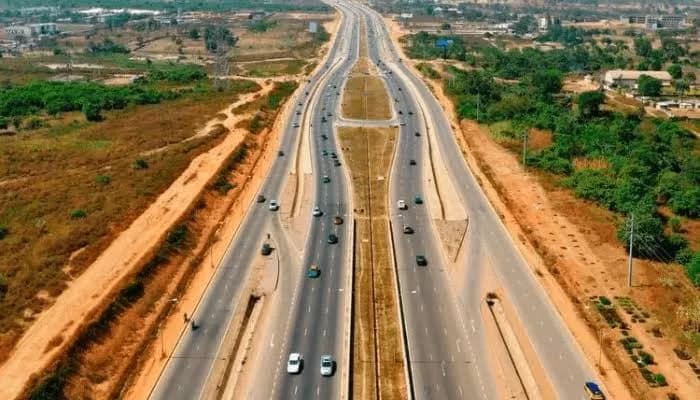
2,700km of road under construction
The largest federal road programme in decades, anchored by two corridors that cross the country end to end — one along the coast, one from the north-west to the south-west.
Lagos–Calabar Coastal Highway 'on course'2,700km+
Federal highways under construction
700km
Lagos–Calabar Coastal Highway
47.47km
Section 1 commissioned in Lagos, May 2026
- Lagos–Calabar Coastal Highway broke ground in March 2024; Section 1 was commissioned in May 2026.
- Continuous Reinforced Concrete Pavement laid on a 30km stretch in Cross River State.
- The Sokoto–Badagry Super Highway runs the second corridor, north-west to south-west.
04 · Energy & clean mobility
CNG and electric vehicles, at scale
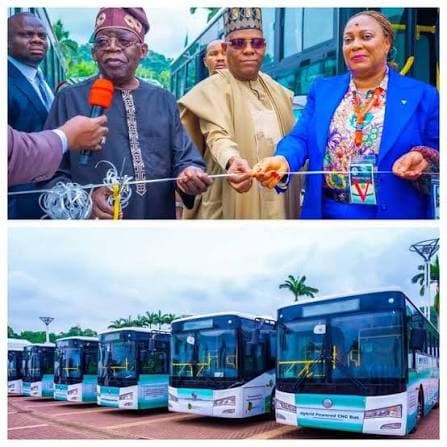
The Presidential Initiative on CNG was expanded in March 2026 to cover electric vehicles — a direct answer to transport costs after subsidy removal, built out through conversion centres rather than announcements.
CNG initiative expanded to electric vehicles100,000
Vehicle conversion kits ordered nationwide
200+
Conversion centres across 23 states
90
CNG refuelling stations
- 655 CNG buses, 5,123 CNG tricycles and 40 electric buses deployed into the transport network.
- Consumer credit for conversions through CrediCorp, Moniepoint and the National Credit Guarantee Company.
- CNG ecosystems, including buses and training centres, being built across 20 universities.
05 · Education & youth
A student loan scheme that actually pays out
The Nigerian Education Loan Fund offers interest-free loans covering tuition and upkeep at federal and state tertiary institutions, verified through the National Identification Number system.
300,000+ students, 900,000 businesses300,000+
Students benefiting from NELFUND
0%
Interest on student loans
NIN
Identity verification, to cut fraud
- Covers tuition and upkeep, not tuition alone.
- Administered digitally, with applicants verified against the national identity register.
- Aimed squarely at families for whom tertiary fees were the binding constraint.
06 · Jobs, MSMEs & enterprise
900,000 businesses reached
The Presidential Loan and Grant Scheme puts capital into micro, small and medium enterprises across all 36 states — the layer of the economy that employs most Nigerians.
900,000+
MSMEs reached by the loan and grant scheme
36 states
Plus the FCT
Digital
Applications, NIN-verified
- Runs alongside MarketMoni, TraderMoni and GEEP for traders and market women.
- CrediCorp extends consumer credit to civil servants, workers and MSMEs.
- N-Power, the NDE and the Nigerian Youth Investment Fund carry the skills and youth-enterprise side.
07 · Wages & social investment
The largest wage rise in Nigerian history
A national minimum wage of ₦70,000 signed in September 2024 — more than double the ₦30,000 benchmark set in 2019 — negotiated with organised labour after subsidy removal raised living costs.
₦70,000 minimum wage takes effect₦70,000
National minimum wage, from September 2024
2.3×
Increase on the previous ₦30,000 benchmark
36 states
Directed to domesticate the new wage
- Agreed with the NLC, TUC and the private sector after months of negotiation.
- Federal support committed for states with revenue constraints.
- Paired with targeted palliatives and the CNG conversion programme to cushion reform.
08 · Trade, investment & refining
Capital is coming back
Capital importation rose almost tenfold between Q1 2023 and Q1 2026, and Nigeria has posted four consecutive quarters of merchandise trade surpluses as domestic refining capacity displaces petrol imports.
$1.13bn → $10.37bn
Capital importation, Q1 2023 to Q1 2026
$895m → $4.01bn
Foreign direct investment, 2022 to 2025
4 quarters
Consecutive merchandise trade surpluses
- Rising crude output alongside sharply reduced petrol imports.
- Domestic refining capacity expanding, changing the import bill structurally.
- Investment figures are the clearest external verdict on the reform programme.
Read it in the President’s own record.
Seven headline claims, the career that produced them, and the coordination brief the Vice President carries alongside.